


Mustafa Hameed
Feb 19, 2025
Urgent, poetic, and searingly relevant, this documentary demands America face its truth.
Raoul Peck redeems Baldwin’s legacy, framing him as the fearless “witness” he was always destined to be.
When the English filmmaker Dick Fontaine approached James Baldwin in Saint-Paul-de-Vence with a documentary film script that aimed to chart the author’s life, literature, and ideas, he was met with fury. “I am not going to let you define me!” Baldwin reportedly shouted. His biographer, David Leeming, later wrote that Baldwin felt violated and misrepresented, his life distorted in Fontaine’s vision. This reaction was quintessentially Baldwin—an intellectual whose existence was shaped by an acute awareness of how he was perceived, and a man who refused to be confined by any singular identity. Black, gay, writer—Baldwin occupied the liminal spaces of each, existing in the cracks of the societies he inhabited. Yet it was precisely this outsider status that shaped him into the formidable writer-activist he became.
Despite his initial resistance, Baldwin eventually allowed Fontaine to follow him through a political pilgrimage in the American South, culminating in the documentary I Heard It Through the Grapevine. In it, an older, more contemplative Baldwin revisits places and people that had shaped him during the civil rights era. “Medgar, Martin, Malcolm,” he reflects, “all dead. All younger than me. But there was another roll-call of people who did not die but whose lives were smashed on the freedom road.”
The documentary was originally intended to bear the title Remember This House—the name Baldwin had chosen for a book he had been working on, an examination of the civil rights movement through its three slain prophets: Medgar Evers, Malcolm X, and Martin Luther King Jr. Their assassinations, each one in rapid succession, left Baldwin grieving as though he had lost members of his own family. He understood these murders not as isolated tragedies, but as the inevitable result of an American history steeped in violence—a country that had, for centuries, nurtured its racial hatred in the marrow of its institutions. For Baldwin, their deaths were more than personal losses; they were existential blows to a people whose hope had been systematically eroded.
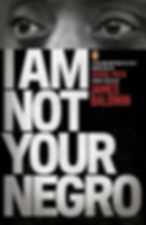
In the years following Baldwin’s death, his contributions to civil rights discourse seemed to recede into the background, overshadowed by the larger-than-life legacies of Malcolm X and Martin Luther King. But in I Am Not Your Negro, Haitian director Raoul Peck attempts to restore Baldwin to his rightful place in the historical consciousness. The film, which seeks to complete the work Baldwin began in Remember This House, is a mesmerizing portrait of a man who refused to be eclipsed by his contemporaries. Baldwin emerges not only as a literary titan but as an uncompromising truth-teller, dissecting the myth of race in America with searing precision.
“I want these three lives to bang against and reveal each other,” Baldwin states, his words given new resonance through the measured narration of Samuel L. Jackson. But this return to the past is fraught with unease. As Baldwin reflects on the deaths of his friends, his voice carries an unmistakable guilt: “Everyone else was paying their dues, and it was time I went home and paid mine.” He had spent years in self-imposed exile in Paris, seeking the distance he needed to become a writer. That exile, however, had come at a cost. A defining moment in Baldwin’s departure from America had been a violent outburst in a diner, when he threw a glass at a white waitress who had refused to serve him. The incident shook him to his core—he understood that if he remained in America, he risked being consumed by the very hatred he sought to escape.
Yet America had a way of pulling him back. Years later, in Paris, Baldwin came across an image of Dorothy Counts, a 15-year-old Black girl walking stoically to school as a mob of white students jeered and spat at her. It was a turning point. “I could no longer justify my absence,” he later wrote. This moment is powerfully rendered in I Am Not Your Negro, where Peck captures Baldwin’s anguish, the depth of his shame, and the moral bankruptcy of a nation that allowed such horrors to unfold.
Peck does not shy away from the uncomfortable truths Baldwin confronted. The film juxtaposes Baldwin’s words with footage of the Black Lives Matter movement, underscoring the cyclical nature of racial violence in America. Baldwin, ever prescient, warned that America was teetering on the brink, its moral decay producing what he called “moral monsters.” For all the rhetoric of a “post-racial” society, the myths and distortions about Blackness endure, propped up by an American consciousness that prefers fantasy to reality. “The story of the Negro in America,” Baldwin reminds us, “is the story of America.”
The documentary also delves into Baldwin’s incisive critiques of Hollywood’s role in shaping racial narratives, echoing Edward Said’s Orientalism in its exploration of how representation is inextricable from power. Films starring Sidney Poitier or the activism of Harry Belafonte take on new meaning when examined through Baldwin’s lens. Peck, to his credit, does not dilute Baldwin’s intellectual rigor in the name of accessibility; in an era obsessed with identity politics and performative wokeness, Baldwin’s insights feel more urgent than ever.
Yet, while I Am Not Your Negro resurrects Baldwin’s political voice with stunning clarity, it offers little about Baldwin the writer—or Baldwin the man. His personal struggles, his literary ambitions, and his private conflicts remain largely unexplored. Perhaps, though, the only way to truly understand Baldwin the writer is to read his works. Peck, instead, chooses to amplify Baldwin’s moral challenge to America, his demand that the nation confront the lies it tells itself.
For Baldwin, neither Malcolm nor Martin offered a wholly sufficient answer to the problem of race in America. He admired both men, yet he remained outside their ideological camps. He rejected Malcolm X’s call for racial separation as a reactionary dead-end, yet he also found King’s unwavering pacifism deeply problematic. He could not align himself with the middle-class sensibilities of the NAACP, nor did he fit neatly into the Black Panther Party’s revolutionary zeal. Baldwin, always the outsider, occupied a space between them all—one that often left him isolated but gave him the clarity to see what others could not.
Peck’s documentary does what Baldwin himself often did—it forces America to look in the mirror. Baldwin’s legacy is not just as a chronicler of race relations but as a relentless interrogator of national myths. And in doing so, I Am Not Your Negro reaffirms Baldwin’s place not just in Black history, but in the story of America itself.
(This was originally published in the Wales Arts Review. This article was a re-edit of the original by the author for Modest Media)